
Before placing an order with a silicone manufacturer, ask about material grade, production process, mold costs, MOQ, quality control, certifications, lead time, and after-sales support. Getting clear answers before production can help buyers avoid unexpected costs, quality problems, and delivery delays.
For custom silicone products, the lowest quotation is not always the most important factor. A reliable supplier should be able to explain how the product will be manufactured, how quality will be controlled, and what you will actually receive at the agreed price.
Ask whether the manufacturer uses food-grade, medical-grade, industrial-grade, or another silicone material, depending on your application.
You should also ask for the relevant material specifications and test reports. For regulated applications, material selection and manufacturing processes can have a direct impact on compliance.
For example, FDA-recognized guidance for silicone medical applications emphasizes appropriate material selection, processing, and quality systems.
Common processes include:
Compression molding
Liquid Silicone Rubber (LSR) injection molding
Transfer molding
Extrusion
The right process depends on the product design, quantity, dimensions, material, and required tolerances.
For example, LSR molding can achieve relatively tight dimensional tolerances in suitable designs, but actual tolerances depend on the material, mold, geometry, and manufacturing process.
Ask for a separate quotation for:
Mold/tooling cost
Product unit price
Prototype or sample cost
Mold modification cost
Packaging cost
Also ask who owns the mold after payment and whether future orders require additional tooling fees.
MOQ can significantly affect your total purchasing cost.
Ask:
“What is your MOQ for the first order, and is the MOQ different for repeat orders or different colors?”
A supplier with flexible production capabilities may be able to support smaller trial orders before larger-scale production.
Don't simply ask, “Is your quality good?”
Ask specifically:
What inspections are performed during production?
How are dimensions checked?
How are appearance defects controlled?
Is hardness tested?
Is there a final inspection before shipment?
Can you provide an inspection report?
Quality documentation can be especially important for products with tight dimensional requirements. Some industrial manufacturers use dimensional inspection reports and capability studies to verify critical features.
Depending on your target market and product application, you may need documentation related to:
FDA, LFGB, REACH, RoHS, CE, ISO 9001, or other applicable requirements.
However, don't assume that a factory having a certificate automatically means your specific product is compliant. Ask which products, materials, and tests the documentation actually covers.
For medical devices, for example, the FDA's QMSR took effect on February 2, 2026 and incorporates ISO 13485:2016 into the U.S. medical-device quality framework.
Ask for a breakdown rather than one general number:
| Stage | What to Ask |
|---|---|
| Design | How long will design confirmation take? |
| Mold | How many days for tooling? |
| Sampling | When can I receive the first sample? |
| Production | How long after sample approval? |
| Packaging | Is packaging included in the lead time? |
| Shipping | How long to my destination? |
This helps you distinguish manufacturing time from total delivery time.
If you are developing a private-label or custom silicone product, ask whether the manufacturer can handle:
Product design
3D drawings and prototypes
Custom molds
Colors and materials
Logo printing or embossing
Custom packaging
OEM/ODM production
Repeat production
A supplier that can support several stages of development can make communication easier as the project grows.
| Factor | What Buyers Should Check |
|---|---|
| Material | Grade, hardness, specifications |
| Manufacturing | Compression, LSR, extrusion, etc. |
| Tooling | Mold price, ownership, modification |
| MOQ | Trial order and repeat-order MOQ |
| Quality | Inspection process and defect control |
| Compliance | Applicable certificates and test reports |
| Lead Time | Mold + sample + mass production |
| Customization | OEM, ODM, packaging and branding |
| Communication | Engineering and production support |
Before confirming your purchase order, make sure you have a written agreement covering:
Product specifications + material + color + hardness + dimensions + mold + MOQ + unit price + packaging + quality requirements + certifications + sample approval + production lead time + shipping terms.
This simple checklist can prevent many misunderstandings between international buyers and silicone manufacturers.
Kangde Silicone is a China-based silicone products manufacturer specializing in B2B OEM and ODM production. With more than 23 years of manufacturing experience, we provide one-stop support from product design and mold development to prototyping, mass production, branding, and packaging. Our factory operates 25+ automated compression molding lines and follows a 12-step quality control process. We support food-grade silicone products and custom silicone solutions for kitchenware, baby products, pet supplies, daily-use products, and other applications. With flexible MOQ, efficient production, and experience serving international buyers, Kangde Silicone helps wholesalers, distributors, and brands turn silicone product ideas into production-ready products.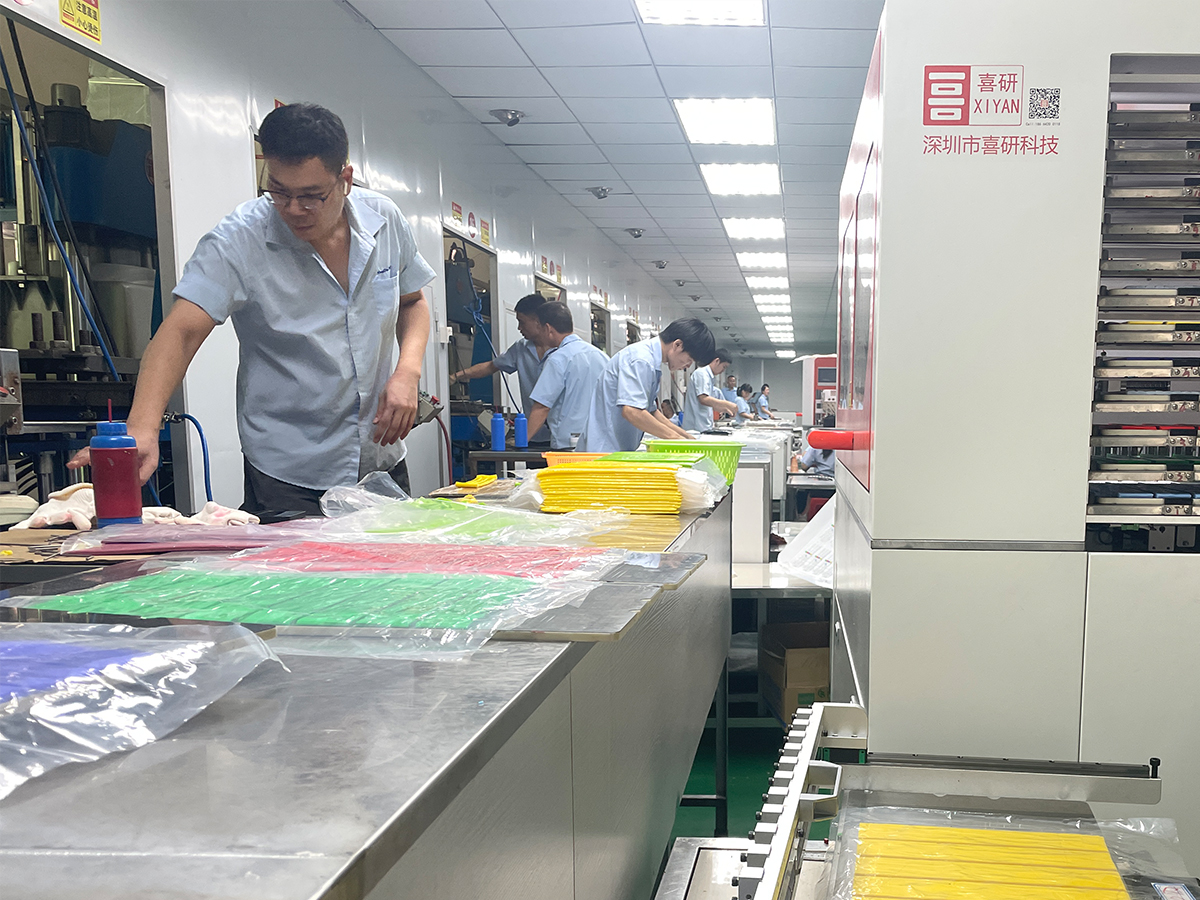
What should I ask a silicone manufacturer first?
Start with the material, manufacturing process, MOQ, mold cost, quality standards, certifications, and production lead time.
How do I know if a silicone supplier is reliable?
Ask for specific evidence such as factory information, quality-control procedures, product samples, certifications, test reports, and clear production specifications.
Should I order a sample before bulk production?
Yes. For custom silicone products, approving a pre-production sample can help confirm dimensions, color, hardness, appearance, and functionality before mass production.
What certifications should silicone products have?
It depends on the product and target market. Food-contact, baby, medical, industrial, and consumer products can have different regulatory requirements. Always confirm which standards apply to your specific product.


